
Contact Form
Swimming Pool Fences & Gates - Safety Guide & Checklist (South Africa)
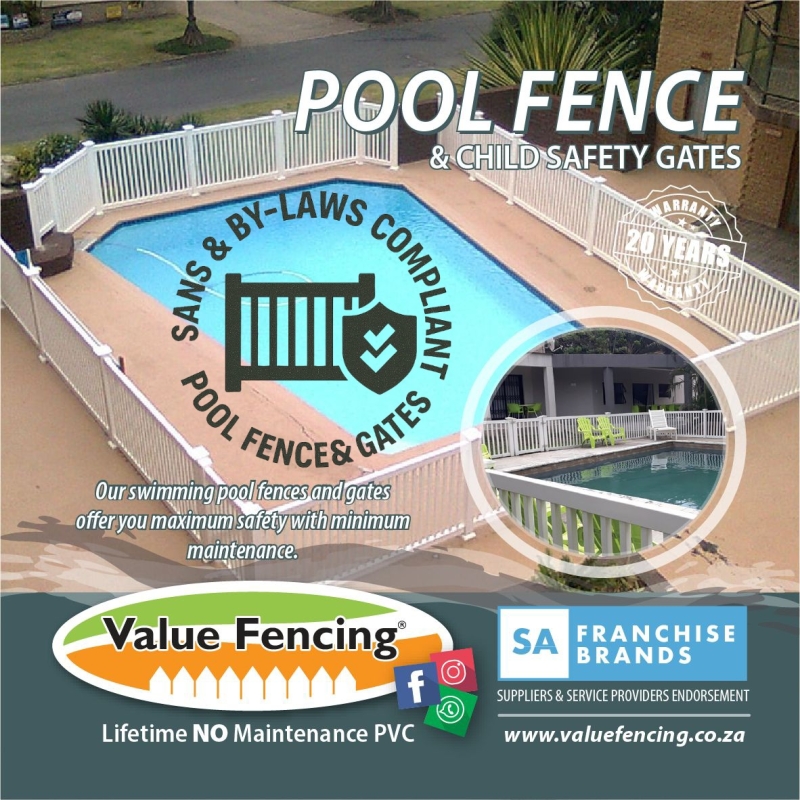
Swimming Pool Fences & Gates - Safety Guide & Checklist (South Africa)
Key Notes
- Must comply with SANS 10400-D (Reg D4/D5) and SANS 10134.
- Fence height: minimum 1.2 m, with gaps ≤ 100 mm.
- Gates: self-closing, self-latching, lockable, latch ≥ 1.5 m, swing outward.
- Multi-layer safety is required: fence + cover/net + adult supervision.
- PVC by Value Fencing® = no maintenance, paintable, 20-year guarantee, 16 years leadership.
- Nationwide coverage in South Africa & Namibia.
Introduction
Swimming pools are a luxury that add lifestyle value to any property-but in South Africa, they also present a significant safety risk. Statistics show that child drownings remain one of the leading causes of accidental deaths in homes with swimming pools.
To address this, South African law requires strict compliance with SANS pool safety regulations, which define the minimum standards for pool fences, gates, and access control.
This guide is the most detailed and technically accurate resource available for homeowners, architects, developers, project managers, estate managers, and property professionals. It explains compliance standards, technical specifications, installation best practices, and why Value Fencing® PVC is the superior choice for long-term, maintenance-free safety fencing.
What South African Inspectors Check (Quick Pass/Fail Guide)
Built for SANS 10400-D / SANS 10134 and common municipal by-laws. Use this as a pre-inspection checklist to avoid repeat site visits.
1) Barrier height (PASS ≥ 1.2 m)
- What they check: Finished height from natural ground on the outside of the fence.
- Why it matters: Reduces climb-over risk for toddlers.
- Fix fast: Raise post and panel line, add compliant extensions, or re-grade exterior ground that reduces effective height.
2) Ground clearance (PASS ≤ 100 mm on hard surfaces; ≤ 50 mm on soil/grass)
- What they check: The largest gap under any panel or gate leaf.
- Why it matters: Prevents crawl-under access.
- Fix fast: Lower panel, add bottom rail/cover strip, or infill/curb on sloped spots.
3) Vertical openings (PASS ≤ 100 mm)
- What they check: Clear spacing between pickets/bars anywhere in the barrier.
- Why it matters: Stops head/torso squeeze-through.
- Fix fast: Insert additional pickets, replace with compliant panel, or add non-climbable infill.
4) Non-climbable design (NO footholds within the first ±1.1 m)
- What they check: Horizontal rails, lattice, braces, or decorative features that form a "ladder."
- Why it matters: Eliminates easy toe-holds.
- Fix fast: Move horizontal rails to the pool side, use flush top rails, or swap to vertical-picket PVC panels.
5) Gate swing & hardware (MUST open outward from the pool)
- What they check:
- Self-closing: Gate returns to closed from any partial open.
- Self-latching: Latch engages automatically on closure.
- Outward swing: Away from water only.
- Why it matters: Prevents a child pushing the gate into the pool zone.
- Fix fast: Fit adjustable spring hinges; set tension; confirm strike/latch alignment.
6) Latch height & location (PASS ≥ 1.5 m above finished ground)
- What they check: Release point height and child-resistant design; some authorities accept "shielded pool-side latch" per spec.
- Why it matters: Keeps the release out of toddler reach.
- Fix fast: Raise latch body, use a compliant magnetic latch (e.g., Tri-Mag type), add latch shield if required.
7) Clearance zone outside the fence (TARGET ≥ 900 mm "no-climb" strip)
- What they check: No climbables within ±0.9 m of the fence exterior-e.g., pots, braais/BBQs, benches, trellises, tap stands, trees/branches, pool pumps.
- Why it matters: Prevents boosting over the barrier.
- Fix fast: Relocate furniture, trim branches, reroute taps/stands, move pump enclosures outside the zone or screen them to spec.
8) Doors & windows opening into the pool area (MAKE SAFE or REMOVE ACCESS)
- What they check (where applicable): Any dwelling/garage/outbuilding door or low window that opens directly into the pool enclosure must be secured-child-resistant locks, self-closing door closers, alarms, or re-planned access so the fence remains the primary barrier.
- Why it matters: Prevents bypass of the fence via the house.
- Fix fast: Add self-closers and top-mounted locks; fit contact alarms; or re-fence to exclude doors/windows from the pool zone.
9) Secondary layer (COVER/NET when pool is unattended)
- What they check: Certified safety cover or net fitted, tensioned, and drainable; fasteners intact; no object > ~100-114 mm can pass under.
- Why it matters: South Africa applies a multi-layer approach: barrier plus cover/net for unattended pools.
- Fix fast: Service/retension existing system; replace worn anchors; ensure rainwater does not puddle on solid covers.
Pro Tips to Pass First Time
- Test like an inspector: From 50 % open, release the gate-it must self-close and latch without help. Repeat 5-10 times.
- Walk the perimeter: Measure the lowest height and largest gap-compliance is judged by the worst point.
- Mind the landscaping: Fresh bark, new turf, or subsidence can change clearances; re-check after garden works.
- Document hardware: Keep latch/hinge model specs handy to show self-closing/child-resistant compliance.
- Estate rules: Some HOAs add aesthetics (style/colour) and sight-line limits-meet both SANS and estate guidelines.
Rapid Self-Check (Owner's Mini Audit)
- Height ≥ 1.2 m ✅
- Any gap (under/through) ≤ 100 mm (≤ 50 mm on soil) ✅
- No horizontal "ladder" rails in first ±1.1 m ✅
- Gate: self-closing, self-latching, opens outward ✅
- Latch ≥ 1.5 m high; lockable ✅
- 0.9 m outside no-climb zone clear ✅
- Doors/windows can't bypass the barrier ✅
- Certified safety cover/net ready for unattended periods ✅
Value Fencing® Advantage (Inspector-Friendly)
- Factory-set self-closing gates with magnetic, child-resistant latches (install height to spec).
- PVC vertical-picket designs with compliant spacing and flush top rails (non-climbable).
- Engineered footings (typ. 30 MPa concrete; post embedment to spec) for consistent clearances.
- Compliance handover: on request, we provide as-installed measurements and hardware specs for your records.
Bottom line: If the fence blocks over/through/under access, the gate always shuts and latches, and no one can bypass it via the house or climbables, you're on track for a South Africa-ready pass.
🎯 Let's dive in deeper to understand what is actually required to conform:
1. Legal & Regulatory Framework in South Africa
National Building Regulations (SANS 10400-D)
Under Regulations D4 and D5, pool owners are legally required to restrict access to swimming pools. Failure to comply is an offence punishable by law. The regulations define fence height, gate operation, and child-proofing.
SANS 10134 - Safety Around Private Swimming Pools
This standard supplements SANS 10400-D by specifying:
- Barrier types permitted (fences, walls, safety covers).
- Requirements for safety nets and covers (load capacity 125-220 kg, water drainage, < 100 mm object prevention).
- Accredited installer obligations.
Local By-laws & Municipal Permits
Municipalities such as Cape Town, Johannesburg, Tshwane, and Durban may impose additional rules. In many cases, building plans must be submitted before installation of a pool or safety fence.
2. Technical Specifications - Fences & Gates
Minimum Fence Height & Gaps
- Pool fences must be at least 1.2 m high measured from ground level.
- Gaps may not allow a 100 mm diameter ball to pass through.
- The fence must be designed to prevent climbing.
Gate Safety Requirements
- Gates must open outward, away from the pool.
- Must be self-closing and self-latching.
- Must be lockable.
- Gate latches must be positioned at 1.5 m or higher from ground level.
Materials & Construction Standards
- Steel must comply with SANS 1390.
- Glass must be toughened safety glass, fitted by accredited installers.
- PVC fencing offers the most durable, non-corrosive, and maintenance-free option.
3. Multi-Layered Safety Approach
South African law requires more than just a fence. Pool owners must adopt a multi-layered safety system:
- Child-proof Fence & Gate - first line of defence.
- Safety Cover or Net - must support adult weight, prevent 100 mm object penetration, drain water quickly.
- Adult Supervision - no barrier substitutes for constant supervision.
- Emergency Equipment & Signage - flotation devices, life hooks, CPR instructions should be on site.
This layered approach ensures that even if one barrier fails, others still provide protection.
4. Professional vs DIY Installation
While DIY kits exist, pool safety barriers must be installed by qualified professionals.
- Incorrect installation can compromise the self-closing or latching functions of gates.
- Posts must be set in concrete (25-30 MPa) with steel reinforcement to prevent collapse.
- Engineers' compliance certificates may be required in estates and complexes.
With professional installation, compliance and safety are guaranteed-giving peace of mind and legal assurance.
5. Why Choose PVC (Value Fencing®)
PVC pool fences and gates by Value Fencing® provide the ultimate no-maintenance safety solution.
- Lifetime No-Maintenance Guarantee - minimum 20 years.
- Virgin uPVC engineered specifically for structural use, with DuPont TiO₂ non-chalking UV stabilisers.
- ASTM F964 certified material for PVC fencing (not conduits or piping).
- Can be painted any colour after installation using acrylic roof paint (light sanding first).
- Designed, CNC-cut, and machine-welded for precision and strength.
- Nationwide coverage across South Africa and expanding into Namibia.
As the original designers of PVC pool fencing in South Africa, Value Fencing® set the standard that competitors only imitate.
6. Quick Safety Checklist
✔ Fence height ≥ 1.2 m
✔ Gaps ≤ 100 mm
✔ Gate self-closing & latching
✔ Latch ≥ 1.5 m above ground
✔ Gate swings outward
✔ Fence non-climbable
✔ Safety net/cover installed
✔ Emergency signage & equipment available
✔ Installed by qualified professionals
✔ Material complies with SANS standards
7. FAQ - Swimming Pool Fences & Gates in South Africa
Q1: How high must a pool fence be?
A: Minimum 1.2 m. Gaps ≤ 100 mm.
Q2: What makes a pool gate compliant?
A: It must be self-closing, self-latching, and lockable, with a latch ≥ 1.5 m above ground, swinging outward.
Q3: Can a safety cover replace a fence?
A: No. Covers and nets are required in addition to a compliant fence.
Q4: Can I install my own pool fence?
A: DIY is not recommended. Compliance requires professional installation and engineering specifications.
Q5: Why is Value Fencing® the best option?
A: As South Africa's original PVC pool fencing company, Value Fencing® provides ASTM-certified material, precision engineering, and a lifetime no-maintenance guarantee.
8. Trusted Local Resources & Links
- South African Bureau of Standards (SABS) - access to SANS documentation.
- National Sea Rescue Institute (NSRI) - Pool Safety - drowning prevention.
- STBB - Swimming Pools & The Law - legal framework.
- Protect A Child Pool Fencing SA - safety rules and layout guidance.
- City of Cape Town - Municipal By-laws - building & safety requirements.
9. Why This Matters
Choosing the right pool fencing is not just about legal compliance-it's about protecting lives. With drowning accidents happening silently and in seconds, a compliant, professionally installed pool fence and gate is a lifesaving investment.
Value Fencing®, the Original & Best, offers the widest range of PVC safety products, unmatched durability, and professional nationwide service. Everything in business is negotiable-except Quality.
child-safe pool barrier, South African building regs, pool gate latch height, SANS swimming pool safety, drowning prevention, maintenance-free fencing, authorised pool fence supplier, pool safety cover standards, accredited installers, DIY pool fencing risks